 Simply Fluent

The Advice Everyone Gives
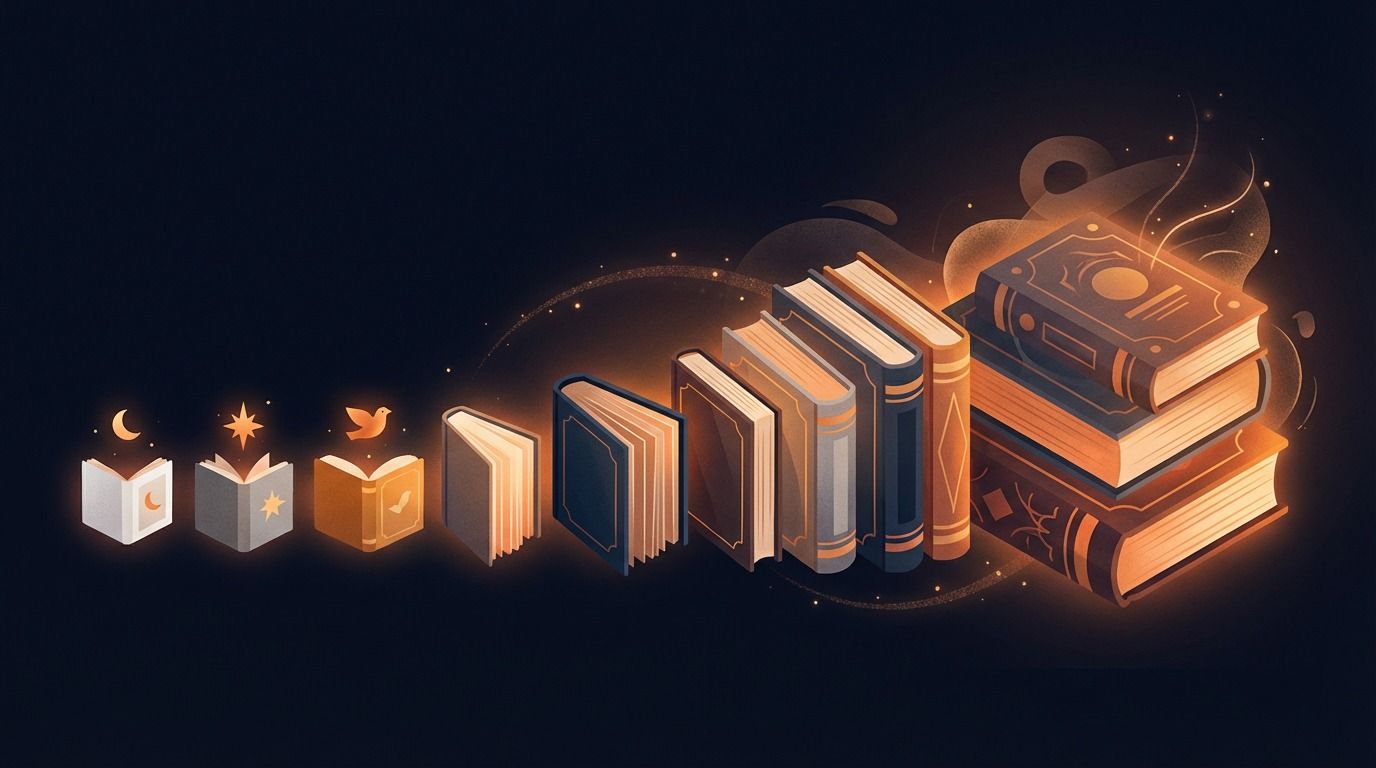
Ask how to start reading in a new language and someone will tell you to start with children's books. Picture books first, then early readers, then chapter books, then young adult, and one day, if you keep climbing, a novel written for adults.
I don't agree that you have to. Nothing is wrong with children's books, and if you enjoy them, read them. But you don't have to climb that ladder before you're allowed a book written for adults.
When I show someone Simply Fluent, I ask if they've tried reading in the language they're learning. Almost always the answer is no, it's too hard. Then I open a book, they read a few lines, and they say "oh, I can read this." That's a book written for adults, not a picture book.
Where the Advice Comes From
The advice has a sound basis, and it's worth understanding before you decide whether to follow it.
Research on reading and vocabulary, much of it by Paul Nation, suggests that to read comfortably on your own, without reaching for a dictionary, you need to know somewhere around 95–98% of the words on the page. Nation's own estimate is at the top of that range: about 98%, or one unknown word in fifty.
That takes a lot of words. In Nation's 2006 analysis of five English novels:
- The most frequent 2,000 word families cover roughly 88% of the words
- 4,000 word families, plus proper nouns, cover roughly 95%
- In Lady Chatterley's Lover, the novel he looked at in most detail, the most frequent 1,000 word families alone cover about 81%
Reaching 98% of a novel takes 8,000–9,000 word families. Children's books are the usual answer because they're shorter and look simpler. The vocabulary is less simple than it looks, though: when Stuart Webb and John Macalister (2013) compared texts written for 7- to 11-year-olds with texts written for older readers, both needed around 10,000 word families to reach 98% coverage. Graded readers, which are written for learners, needed about 3,000.
The important words there are "on their own." The 98% figure describes reading without help.
What Changes When a Translation Is One Press Away
The reason unassisted reading needs so much vocabulary is the cost of each word you don't know. With a paper book and a dictionary, every unknown word means stopping, looking it up and finding your place again. Do that on every line and you lose the story.
I know this from my own start. When I first tried to read a book in Dutch, I had the paper book in one hand and Google Translate on my phone in the other. Every word meant unlocking the phone, typing the word, spelling it right and finding my place on the page again. I gave up after a couple of pages. The book wasn't the problem. The lookups were.
When you can select a word and see its meaning in the sentence, an unknown word costs you very little, and you're still in the same sentence. That changes what counts as too hard. At around 90%, one unknown word in ten, reading on your own is a struggle: in Hu and Nation's 2000 study, only 4 of 16 readers understood a story adequately at that level. With a translation one press away, the same page is workable, and you meet a lot of new words on it. Research on glosses, translations of unknown words given right next to the text, points the same way: a meta-analysis of 11 studies by Lee Abraham (2008) found that computer glosses improved reading comprehension, and a meta-analysis of 42 studies by Yanagisawa, Webb and Uchihara (2020) found that learners who read with glosses learned more of the unknown words than learners who read without them. You'll look up a lot at first. It gets less as the same common words keep coming back, which they do, because they're common. (I wrote about that in the compound effect of reading.)
So the thing the ladder protects you from, drowning in unknown words, is a much smaller problem than it used to be.
Why You Might Pick a Book for Adults
What carries you through a first book in another language is wanting to know what happens next. If a story written for a five-year-old does that for you, great. If it doesn't, you can pick something that does.
The full ladder, picture books to early readers to chapter books to young adult, means reading a lot of things you might never choose in your own language. Some people enjoy that, and if you do, it's a good way in. If you'd rather read something you care about and want to come back to, you don't have to climb the ladder first.
You don't miss the basics by starting with a book for adults. The most common words in a language are the same words that fill every novel. A novel set in a bakery uses the same words for bread, flour and oven as a picture book about a bakery. You meet the common words anyway, in any book, over and over. The difference is whether you're meeting them in a story you care about.
How I Started
For Spanish, I spent six to eight weeks learning my first few hundred words with flashcards in Anki, and then I started reading my first book. In hindsight I could have spent much less time on the flashcards.
For Portuguese, I started from nothing but my Spanish, which helped a lot: similar words, similar grammar, similar sentence structure. The first book I read in Portuguese was 300,000 words long. It took me 26 hours of reading to finish it, and after that I was having my first conversations in Portuguese.
Your starting point won't be the same as mine, and a language far from anything you know will take longer. But the order doesn't have to change: learn enough words to get going, then open a book you want to read.
When Children's Books Are a Good Choice
None of this means you should avoid them. A children's book is a good choice when:
- You want to read it. Some children's books are wonderful, and if one is what you'd pick, pick it.
- You're reading with your kids. Reading to a child in the language you're both learning is a good habit for both of you.
- You want a quick first win. Finishing a short book quickly shows you it can be done. Just don't feel you have to stay there.
- The pictures help you. In an illustrated book, the picture often tells you what a word means. Allan Paivio's dual coding theory, from 1971, suggests that words linked to images as well as text are easier to remember.
What matters is the reason. Read a children's book because you want to, not because a ladder says you have to earn your way to a novel.
If You Want to Start With a Book for Adults
If you'd rather start with a book written for adults, three things make a first book easier:
- Keep it short. A 150-page book you finish does more for you than a 500-page one you abandon.
- Pick something familiar. A book you've already read in your own language, or a story you've seen the film of. When you know the plot, all your attention goes to the language.
- Pick something that pulls you forward. Thrillers, mysteries, romance, adventure: whatever makes you want to read one more chapter.
There's more on this in how to pick your first book in another language.
Start With the Book You Want
You don't have to earn your way to a novel. Pick the kind of book you'd read in your own language, keep a translation within reach, and start with the first page. It will be slow at first, and it gets faster the more you read.