 Simply Fluent


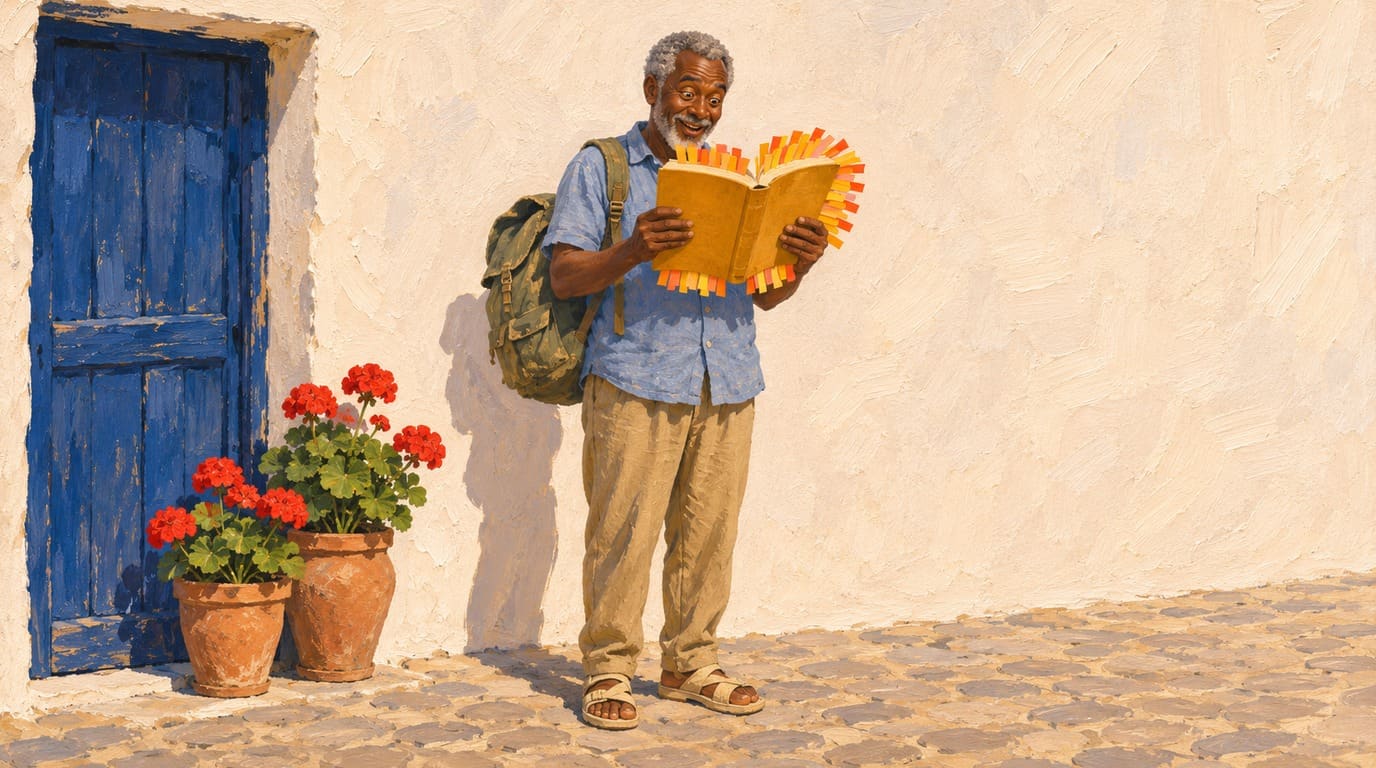
When I learned Spanish, I didn't take a class. I spent six to eight weeks learning my first few hundred words with flashcards, and then I started reading my first book in Spanish. After about four months of learning I spent five weeks on my own in Colombia, and I got by in Spanish.
So yes, you can learn Spanish by reading books, and Spanish is a good language to do it in. Reading gave me the words and the grammar. What it didn't give me was practice speaking: that came in Colombia, when I was on my own and had to use it. Below is what reading does and doesn't do, where to start at your level, what to read in Spanish, and what to do with the words you don't know.
Can you learn Spanish just by reading books?
You can learn most of what you need to understand Spanish. In a 2015 meta-analysis, Takayuki Nakanishi combined 34 studies with 3,942 participants and found that learners who did extensive reading, meaning a lot of reading of easy texts, improved their reading proficiency more than learners who didn't. He concluded that extensive reading should be part of language learning.
Those studies measured reading. Speaking is a separate skill: you have to build sentences yourself, quickly, while someone waits for you. Reading gives you the words and shows you how sentences are put together, so you have something to say. You still have to practise saying it. If speaking is your goal, read and talk, not one or the other.
Why is Spanish a good language to learn by reading?
Spanish spelling tells you how a word sounds. Philip Seymour, Mikko Aro and Jane Erskine tested children learning to read in 13 European spelling systems, English among them, near the end of their first school year. Spanish children read about 95% of a list of familiar words correctly, and about 89% of made-up words they had never seen. English-speaking children in Scotland read about 34% of the familiar words correctly. The authors put the difference down to how closely spelling follows sound in each language, and how complex its syllables are. Those were children learning to read their own language, but the point carries over: in Spanish, a new word you meet in a book is a word you can say out loud.
A small set of words covers most of a page. Mark Davies counted how much of written and spoken Spanish the most frequent words make up, counting all forms of a verb, such as pintamos and pintarás, as one word. In his figures, the 1,000 most frequent words made up 79.6% of the words in fiction. The next 1,000 added 6.5%, and the 1,000 after that only 3.5%.
That tells you two things. The most common words pay off quickly, so they are worth learning on purpose. After that, each new thousand covers less of the page, and you won't learn the thousands of less common words from a list. A book puts them in front of you in a sentence, with the common words you already know around them.
Where should you start at your level?
Find out where you are first. The Spanish level test has you read three short passages and places you on the CEFR scale, A1 to C2, in about five minutes and without signing up.
- Starting from zero: learn the most common words before you open a book. There is a free deck of the 100 most common Spanish words that runs in the browser, without an account. I spent six to eight weeks on flashcards before my first book, and in hindsight I could have spent much less.
- A1 and A2: short stories and graded readers written for learners at your level, so you know most of the words on the page.
- B1: longer graded readers, or a Spanish translation of a book you have already read in your own language. You know the plot, so your attention goes to the language. There is more on choosing in how to pick your first book in another language.
- B2 and up: novels written for Spanish readers. If you are not sure you are ready, here is how to tell when to move up a level.
How long the library's stories are at each level is in Spanish books by level.
The reason for starting with books written for learners is the number of words you need. Stuart Webb and John Macalister analysed 688 texts to find how many words a reader needs to know 98% of the words on the page, about one unknown word in fifty. For graded readers it was about 3,000 word families. For books written for older readers it was about 10,000 words. The texts they studied were in English, but the gap is the same reason graded readers exist in Spanish.
Can you learn Spanish by reading children's books?
You can, but they are not the easy step they look like. In the same study, books written for children needed about 10,000 words too, the same as books for older readers. The plots are simple, but the words are not. If there is a children's book you want to read in Spanish, read it. If you are choosing one only because it should be easy, a graded reader at your level will be easier. I wrote more about this in whether children's books are a good start for adult learners.
Spanish books by level
The levels below are the European scale from A1 (beginner) to C2. These are the short stories in the Simply Fluent library, at the level the library gives them. The better test is still the first page: if you know nearly every word, it fits.
A1
The Spanish stories at A1 run from 617 to 817 words, for example El abuelo no duerme (669 words) and Nuestra puerta es roja (643 words). That is one sitting each.
A2
At A2 most of the library's Spanish stories run from about 500 to 1,400 words. Two are longer: La llamada del balcón has 2,215 words and ¿Quién vive en 4A? has 3,733.
B1
The library's B1 stories run from 1,387 to 2,416 words, such as Héctor no lo hizo (1,560 words).
B2 and after
The shorter B2 stories run from Sellado en la arcilla (1,737 words) to Nadie le paga al fantasma (2,516 words). After those, the library goes up to Un billete a la Tierra (17,614 words), with Bajo la superficie (5,363 words), El hombre que perdió el martes (9,220 words) and Nube sobre la Montaña de la Mesa (14,084 words) along the way. After that, a novel in whatever you already like to read.
What should you read in Spanish?
Something you want to read. If you read thrillers in your own language, read a thriller in Spanish. If a book bores you, put it down and pick another one. You will read more of a book you like.
Spanish from Spain or from Latin America? There is one difference you will see on the page. According to the Spanish Royal Academy's dictionary of doubts, vosotros is the informal "you" for a group in most of Spain, with its own verb forms such as calláis or escribisteis. In Latin America, and in the Canary Islands and western Andalusia, those forms aren't used, and people say ustedes instead. A novel from Spain can have vosotros in its dialogue; one from Mexico or Colombia won't. If you know where you will use your Spanish, start with books from there. Either way, it is one set of verb forms to recognise, not a different language.
Free books. Project Gutenberg has a list of free ebooks in Spanish, including Don Quijote and La Regenta. They are free because they are in the public domain, and classics like these are hard going for a learner, so save them for when you read novels comfortably. The library's Don Quijote is that public-domain text, a bit over 380,000 words.
What do you do with words you don't know?
Skip the ones you can do without. If you still follow what is happening, keep reading. Many words you skip will come back later in the book.
Look up the ones that stop you. When a word keeps coming back, or you lose the thread without it, look it up. In a 2020 meta-analysis of 42 studies, Akifumi Yanagisawa, Stuart Webb and Takumi Uchihara found that reading with the meaning of unknown words given on the page led to more words learned than reading without it: about 45% of the tested words against 27% right after reading, and about 33% against 20% on later tests. Meanings given in the reader's own language led to more learning than meanings given in the language being learned, so at the start, look words up in your own language rather than in a Spanish-only dictionary.
Watch the words you think you know. Many Spanish words look like English ones, and some of them mean something else. Éxito means success, not exit. The first meaning of librería in the Academy's dictionary is a shop that sells books. If a sentence stops making sense around a word you thought you knew, look that word up too.
Make each lookup quick, so you stay in the story. In Simply Fluent, you can import your own Spanish books or read stories from the library, which is graded by level. You select a word or phrase and see its meanings, with the one it has in that sentence highlighted. A translation you save is shown above that word or phrase in every book you read in Spanish, so you don't look the same word up twice.
Where should you start?
Take the level test, pick one book at that level that you want to read, and read for ten minutes a day. Look up the words that stop you, skip the rest, and keep going. If you want the same approach for any language, I wrote about how to learn a language by reading.
Sources
The research and the Academy pages were checked on November 7, 2026. The library word counts were checked on November 18, 2026.
- Nakanishi, T. (2015). A meta-analysis of extensive reading research. TESOL Quarterly, 49(1), 6–37: doi.org/10.1002/tesq.157
- Seymour, P. H. K., Aro, M., & Erskine, J. M. (2003). Foundation literacy acquisition in European orthographies. British Journal of Psychology, 94(2), 143–174: doi.org/10.1348/000712603321661859
- Davies, M. (2005). Vocabulary range and text coverage: Insights from the forthcoming Routledge Frequency Dictionary of Spanish. In D. Eddington (Ed.), Selected Proceedings of the 7th Hispanic Linguistics Symposium (pp. 106–115). Cascadilla Proceedings Project: mark-davies.org/articles/davies_26.pdf
- Webb, S., & Macalister, J. (2013). Is text written for children useful for L2 extensive reading? TESOL Quarterly, 47(2), 300–322: doi.org/10.1002/tesq.70
- Yanagisawa, A., Webb, S., & Uchihara, T. (2020). How do different forms of glossing contribute to L2 vocabulary learning from reading? Studies in Second Language Acquisition, 42(2), 411–438: doi.org/10.1017/S0272263119000688
- Real Academia Española and ASALE, Diccionario panhispánico de dudas, 2nd edition, "vosotros, vosotras": rae.es/dpd/vosotros
- Real Academia Española and ASALE, Diccionario de la lengua española, "éxito" and "librería": dle.rae.es/éxito, dle.rae.es/librería
- Project Gutenberg, Browse by language: Spanish: gutenberg.org/browse/languages/es
- Word counts: the Spanish editions in the Simply Fluent library, 18 November 2026. Don Quijote is the public-domain Spanish text. The library records it as 381,558 words and, separately, 383,892, so the post says a bit over 380,000.
Common questions
- Can I learn Spanish just by reading books?
You can learn a lot of Spanish by reading: words, grammar as it is used, and reading speed. A 2015 meta-analysis of 34 studies found that extensive reading improved learners' reading proficiency. Those studies measured reading, not speaking, so plan to talk to people too once you have the words.
- How do I learn Spanish by reading?
Learn the most common words first, then read books at your level about things you want to read. In fiction, the 1,000 most frequent Spanish words make up about 80% of the text. Look up the words that stop you from following the story and skip the rest.
- Can I learn Spanish by reading children's books?
Yes, if you want to read them, but they are not as easy as they look. A study of 688 texts found that books written for children needed about as many known words as books for older readers, while graded readers written for learners needed far fewer.