 Simply Fluent

Why Reading in Another Language Is Tiring
You sit down with a book in your target language. You're focused, engaged, determined. Twenty minutes later, your brain feels like it just ran a marathon. You're mentally drained in a way that two hours of reading in your native language never produces.
This isn't weakness. This isn't a sign that you're bad at languages. If you understood what was happening inside your skull during those 20 minutes, you might feel proud rather than exhausted.
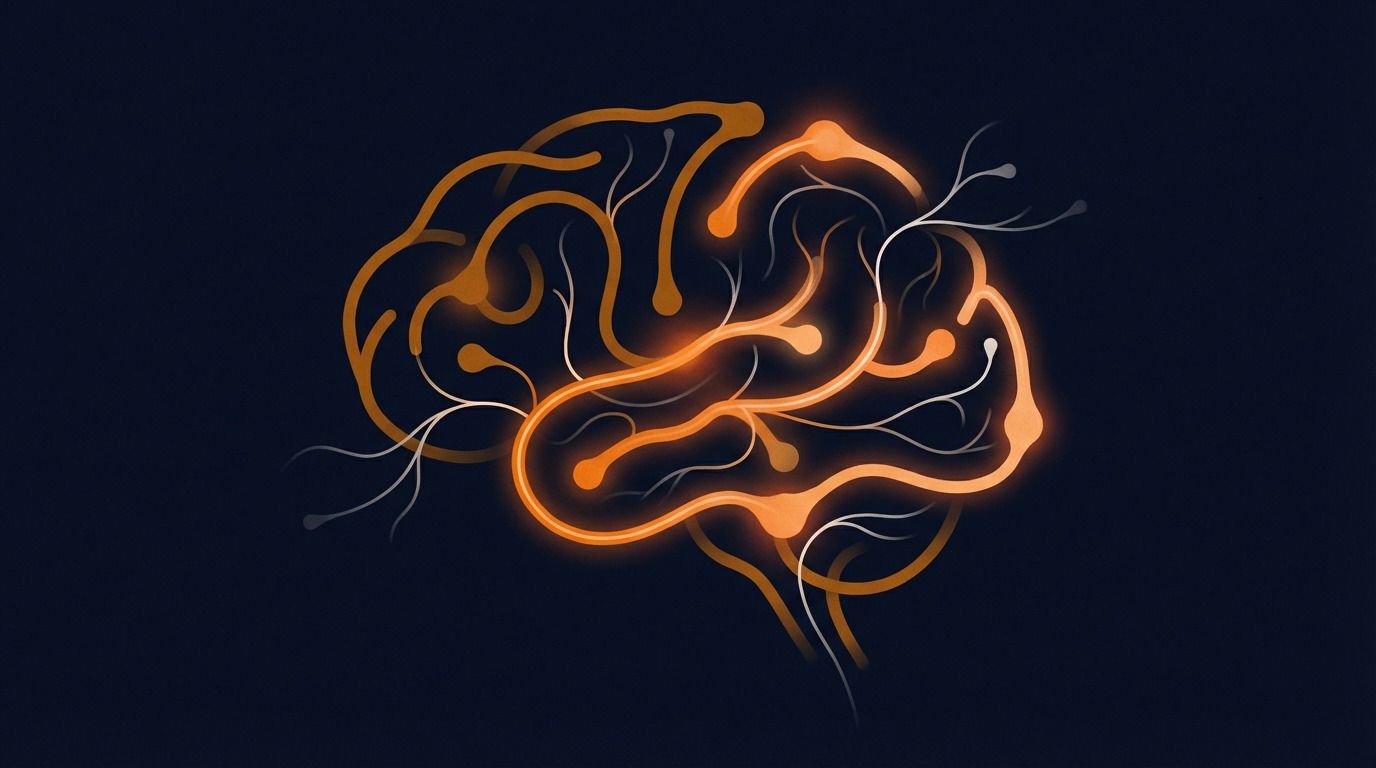
Because when you read in a foreign language, your brain is doing more work than when you read in your first language. Brain imaging studies show wider activity, including in areas involved in control. The tiredness you feel is what that extra effort feels like.
Your Brain on Native Language Reading
To understand what happens when you read in a second language, it helps to understand what happens when you read in your first.
When you read in your native language, the process is remarkably efficient. Your brain has had decades of practice, and it has built streamlined neural pathways specifically for this task. Put very simply: visual areas process the shapes of letters, areas in the left temporal lobe (including Wernicke's area) are involved in comprehension, and areas in the left frontal lobe (including Broca's area) are involved in grammar and sentence structure.
These regions work together, and the whole process is so automatic that you're not aware of it. Your eyes move across the page and you understand what you read.
Psychologists call this "automaticity": after thousands of hours of practice, a skill takes very little conscious effort.
Your Brain on Second Language Reading
Now here's where things get interesting. When you read in a second language, especially one you're still learning, the picture looks different inside a brain scanner.
More Brain Activity, More Effort
In a 2008 review of brain imaging studies, the neuroscientist Jubin Abutalebi concluded that a second language is processed by the same brain network as the first. The difference is that a less proficient second language shows more extended activity, including in areas associated with control:
- Executive control (the prefrontal cortex): keeping the second language selected and your native language out of the way
- Conflict monitoring (the anterior cingulate cortex): managing competition between your two languages
- Language selection (deeper structures such as the caudate): helping choose which language is in use
You have probably noticed this yourself. Reading in your second language, you can feel your brain working harder. It is not just understanding the words. It is reading, working out meaning, and keeping words from your first language out of the way, all at once.
That sensation is real. Your brain is doing more work.
The Competition Between Languages
One of the better-supported findings in bilingual research is that both of your languages stay active, even when you're only using one. When you read a word in your second language, your brain doesn't neatly switch off your first language. Instead, it activates potential matches in both languages simultaneously.
This means your brain has to do extra work to select the right language. When a Spanish-English bilingual reads the English word "red," their brain briefly activates both the English meaning (the color) and the Spanish word "red" (meaning network). This competition requires cognitive resources, which is part of why L2 (second language) reading feels more effortful.
Here's an example of what that can look like. Say you know some Portuguese and are now reading German. You see "Haus," and the Portuguese "casa" comes to mind before "house" does.
Managing that competition between languages is part of the work.
The Effort Is How It Gets Easier
Here's the part that should make you feel better about that post-reading exhaustion: the extra effort you spend reading in a second language isn't wasted. It's part of how the language becomes easier.
Building New Neural Pathways
Every time you read a word in your second language, you get a little faster at recognizing it. The first time you encounter "Schmetterling" (butterfly in German), your brain has to work hard: recognizing the unfamiliar letter combination, retrieving the meaning, connecting it to your existing knowledge. Recognition is slow.
Each time you meet it again, recognizing it gets a little faster, until you recognize it almost automatically. Learning of this kind is thought to rely on changes in the connections between neurons, built up through repeated use.
Reading provides a lot of repeated exposure in context. Unlike flashcard review, where you see a word in isolation, reading gives you each word in a meaningful sentence, which gives you more to connect it to.
The Brain Gets More Efficient Over Time
Abutalebi's review also points to something encouraging: the extra activity may disappear once a learner reaches more native-like proficiency, as processing of the second language shifts from controlled to more automatic. The pattern for L2 (second language) processing comes to look more like L1 (native language) processing.
In other words, the more you practice, the more efficient your brain becomes. The exhaustion you feel after 20 minutes of L2 reading today doesn't have to last. With consistent practice, reading gets less effortful.
For example, at first one page in your target language might take you ten minutes and leave you wiped out. With enough consistent reading, you may find you can read for an hour and it feels almost normal. Not quite as effortless as your native language, but close.
Cognitive Benefits Beyond Language
Does the effort of L2 reading do anything for your brain beyond the language itself? Possibly, but the evidence here is less settled.
Executive Function
Managing two languages makes heavy use of your brain's executive control network. Some studies have found that bilingual individuals perform better on tasks like switching between activities, filtering out distractions, and holding multiple pieces of information in working memory.
It's worth noting that this "bilingual advantage" is debated among researchers. Some large studies have failed to replicate the effect, and the picture is more nuanced than early headlines suggested. What's less disputed is that the process of learning and using a second language engages these executive control systems heavily. Whether that translates into a measurable general advantage is still an open question.
Cognitive Reserve
Some of the most compelling research on bilingualism and brain health suggests that maintaining two active languages builds "cognitive reserve," a kind of neural resilience that may help protect against age-related cognitive decline. This research is still evolving and easy to overstate. Several studies have found an association between bilingualism and later onset of dementia symptoms, others have not, and an association doesn't show that one causes the other.
The proposed explanation is sustained, complex mental activity over many years, which is the kind of activity L2 reading involves.
What This Means for Your Reading Practice
Understanding the neuroscience of L2 reading changes how you should think about your practice.
Exhaustion Is a Good Sign
When you feel mentally tired after reading in your target language, it doesn't mean you're doing it wrong. It means your brain is working hard. Take breaks when you need them, and know that the fatigue is not a sign of failure.
Reframe those 20 minutes before you need a break. Of course you are tired: your brain is doing more work than it does in your native language. Those 20 minutes are a workout, not a limitation.
Consistency Matters More Than Duration
Memory research has found many times that practice spread out over time is remembered better than the same amount of practice crammed into one session. This is called the spacing effect; Cepeda and colleagues reviewed more than 300 experiments on it in 2006. So if you have about two hours a week for reading, 15 to 20 minutes a day is likely to do more for you than one two-hour session.
Daily reading also means you meet the same words again after a gap, which is the kind of repetition the spacing effect is about.
Context Enriches Neural Representations
When you learn a word in context (surrounded by other words, embedded in a meaningful sentence, connected to a narrative) you have more to connect it to than when you learn it in isolation.
You don't just store "Schmetterling = butterfly." You store "Schmetterling = butterfly, in a garden scene, in spring, near words about nature." Those links give you more ways to recall the word when you need it. It's also why I built Simply Fluent around reading: a translation you save is shown above that word in every book you read after that, so you keep meeting it in new sentences.
Your Brain Adapts to What You Practice
You get better at what you practice, but it doesn't stay neatly in one skill. When I learned Dutch, I had almost no listening practice. The app had no audio yet, and I barely heard any Dutch. I was reading every evening, and then I found I could understand the words people were saying around me. I was surprised myself.
For well-rounded language proficiency, combine reading with other forms of input and output. But if reading is your main practice, that's a solid base to build on. Once I started reading in Dutch, reading was nearly all I did, and it got me to the point where I could follow a walking tour given entirely in Dutch.
From Effortful to Automatic
The progression from effortful to automatic reading tends to look something like this:
Early stages: Wider brain activity. High cognitive effort. Slow processing. Frequent exhaustion. Heavy reliance on translation and executive control.
Intermediate stages: Processing speeds up. Longer reading sessions become possible. Translation becomes less conscious.
Advanced stages: Brain activity looks more like native language reading. Processing becomes largely automatic. Reading feels enjoyable rather than effortful.
At some point you may notice you have been reading for a long stretch without thinking about your native language once. You are not translating anymore. You are just reading.
It is not a miracle. It is thousands of pages of reading, each one making the next page slightly easier.
Keep Reading
Every time you open a book in your target language, you're learning vocabulary and grammar, and you're training your brain to process the language with less effort.
The difficulty you feel isn't a sign that something is wrong. Your brain is working hard because it's learning to read in a second language.
So pick up that book and read your 15 minutes. The effort you feel today is what makes the next page easier.